Tonightbox: The Sky Console on a Nightstand
The sky console answers 'is tonight worth it?', but only if I open a browser. So I put it on a $15 touchscreen beside the bed: verdict, timeline and plan, dimming itself in the dark.
Last week I wrote about Setec’s sky console, the web page on my homelab that decides whether tonight is worth carrying the telescope outside. It works. It has one flaw, which is that it lives in a browser tab, and the moment I most want the answer is when I’m already in bed wondering whether to set an alarm for the dark window.
I had a spare Cheap Yellow Display on the desk. If you haven’t met one: an ESP32 with a 2.8-inch 320 × 240 touchscreen soldered to it, a light sensor, a speaker nobody uses, and a price around fifteen dollars. It is the kind of board you buy two of because the shipping costs more than the second one. An afternoon later it was a box that answers the question from across the room.
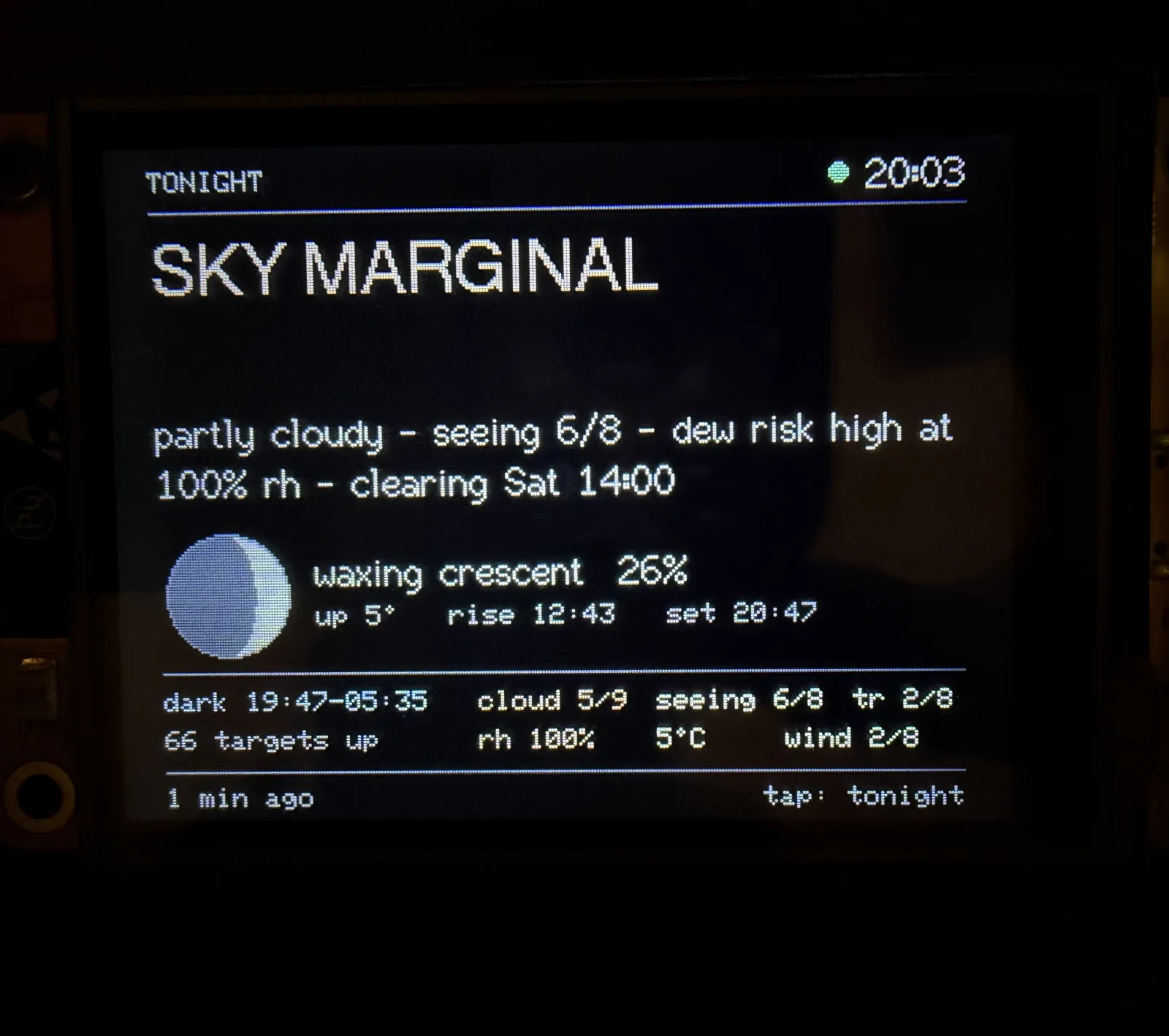
What it does
Every five minutes it fetches the console’s state.json over Wi-Fi, the same file the web page reads. It never talks to the mount, and it never talks to anything on the internet. The server already did the ephemeris, the forecast fetch and the ranking; the box just has to draw.
There are three pages. A tap anywhere flips to the next one, and after a few minutes without a tap it drifts back to the first.
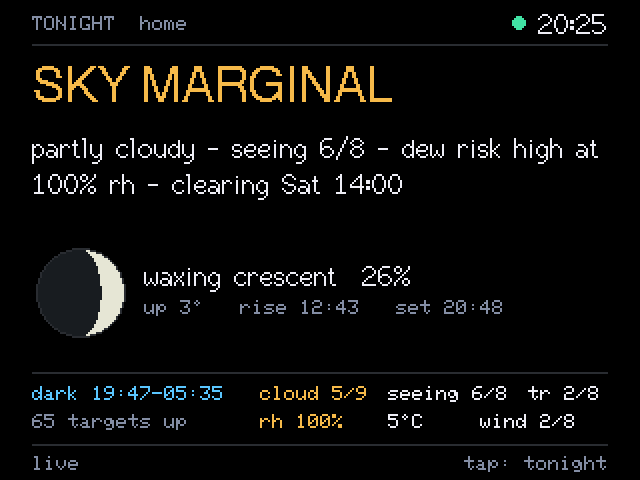
Verdict. The console’s one-line call, in its colour: green for go, amber for marginal, red for no-go, and during the day just the sky state and when it gets dark. Under it, the reasons in the console’s own words. Then the Moon, drawn with its actual phase, with how high it is and when it rises and sets. Along the bottom, the dark window and tonight’s cloud, seeing, transparency, humidity, temperature and wind on the 7Timer scales.
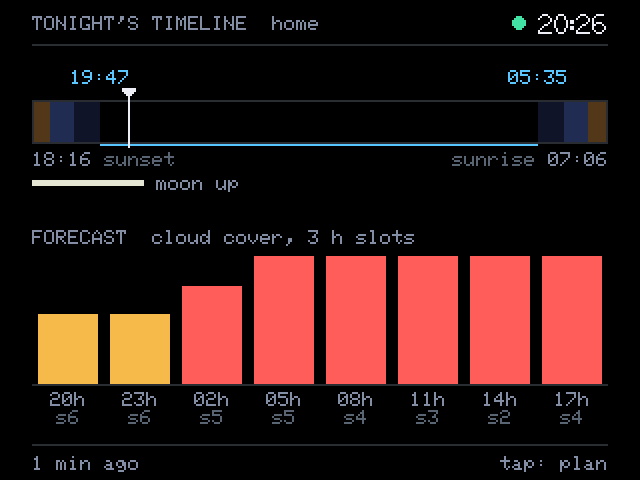
Timeline. Sunset to sunrise as one bar. The coloured ends are the three twilights going down and coming back up, the black middle is astronomical dark with its hours labelled above, the white marker is now. The thin bar under it is when the Moon is up. Below that, the forecast as eight bars, one per three-hour slot, height is cloud cover, colour is the verdict rule, with the seeing number under each.
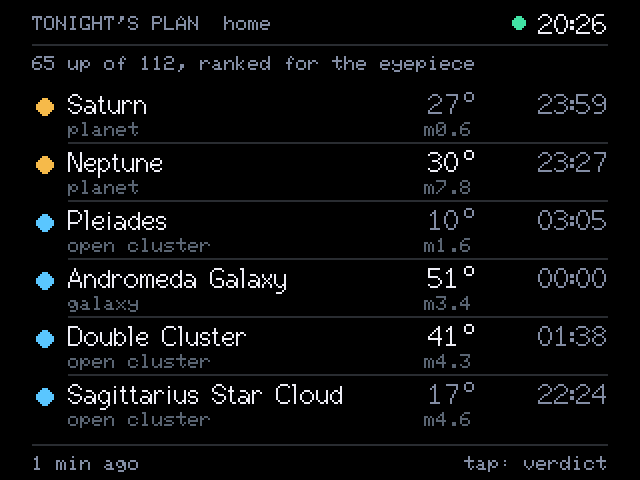
Plan. The top six of tonight’s ranked list. Planets get an amber dot, deep-sky objects a blue one. Altitude now, magnitude, and the best time to look, which turns green when the answer is “now”.
Bedside manners
A screen beside the bed has rules. The light sensor on the board, which more or less reads “room lit” or “room dark”, drives the backlight, so in a dark room it sits at eight percent and in daylight it comes up. Holding a finger on the screen for a second pins it lower still, which is night mode, and another hold releases it. The RGB LED stays off. It never beeps.
The background is pure black for a reason I found out the hard way. The web console uses a very dark navy, and the first build copied it. On this panel that navy reads as a bright, saturated blue; cheap TFTs lift their darkest levels, and a dimmed backlight makes it worse. Black is black.
Small screen, small fights
The whole thing is about 450 lines of Arduino C++ on top of TFT_eSPI and ArduinoJson. A few things were less obvious than they look.
The state file is around 22 KB, most of it a ranked list of ninety targets with a dozen fields each. ArduinoJson can parse through a filter, so the box keeps six fields of the first six targets and a handful of top-level numbers, and the rest never touches memory. Heap use is about 15 percent.
The built-in fonts stop at ASCII 127. The console separates its reasons with a middle dot, which the fonts simply drop, so “seeing 6/8 · dew risk” rendered as “seeing 6/8dew risk” until the strings were flattened to ASCII with a dash. The degree sign is the same story: the only font that has one draws it as a dot, so the box draws a tiny circle instead.
Text wider than the screen does not wrap or clip. It just keeps going past the edge. “ASTRONOMICAL TWILIGHT” in the big font is 353 pixels wide on a 320-pixel screen, which I discovered by looking at the screen. Long labels now wrap onto two lines, and every piece of the lower rows is placed where its longest possible value is known to fit.
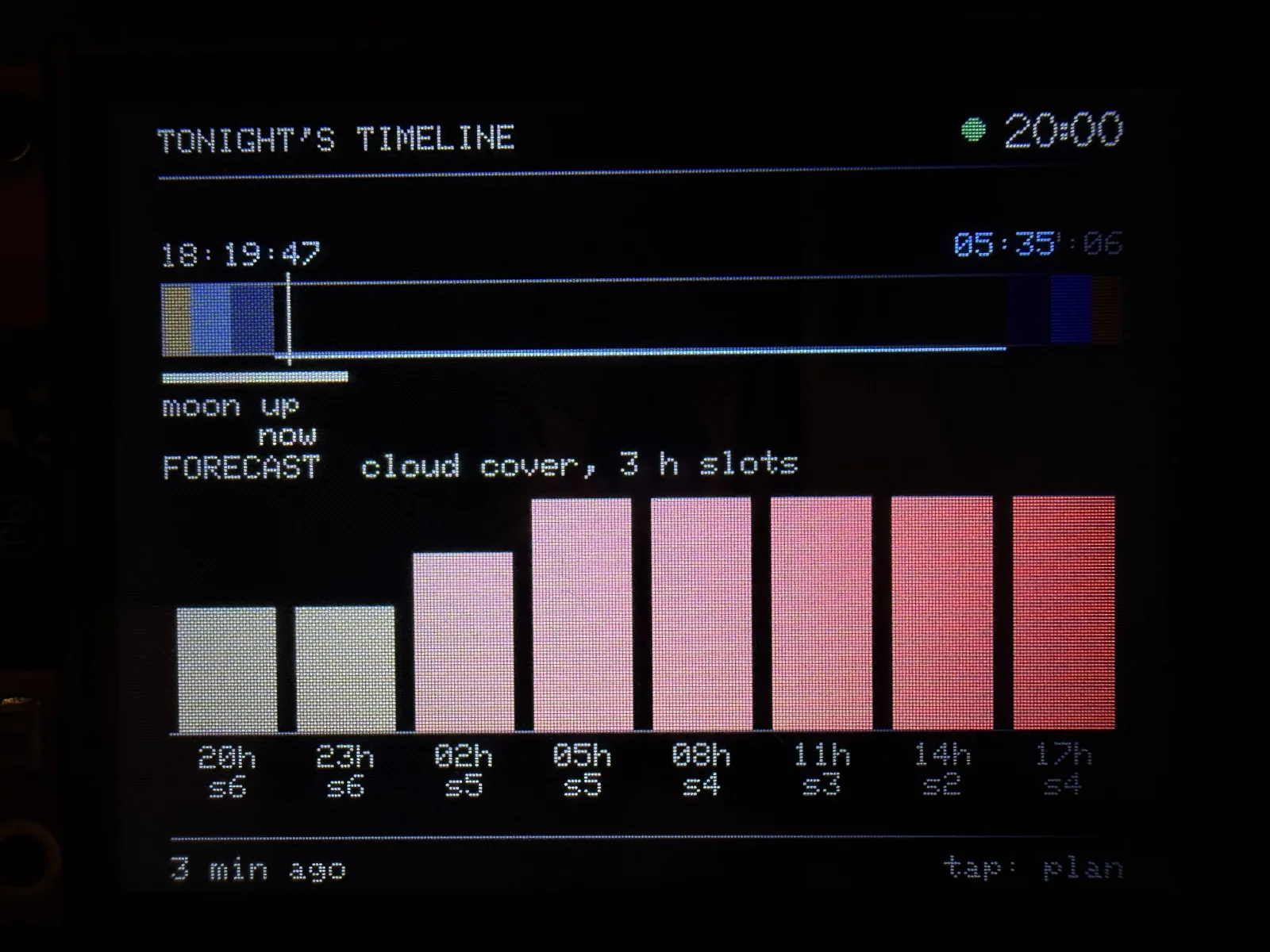
It has been on the nightstand for one evening. Tonight is marginal, clearing Saturday afternoon, Saturn best at midnight. I didn’t have to open anything to know that.